SlimSet Official Website › Ingredients
IngredientsSlimSet Ingredients
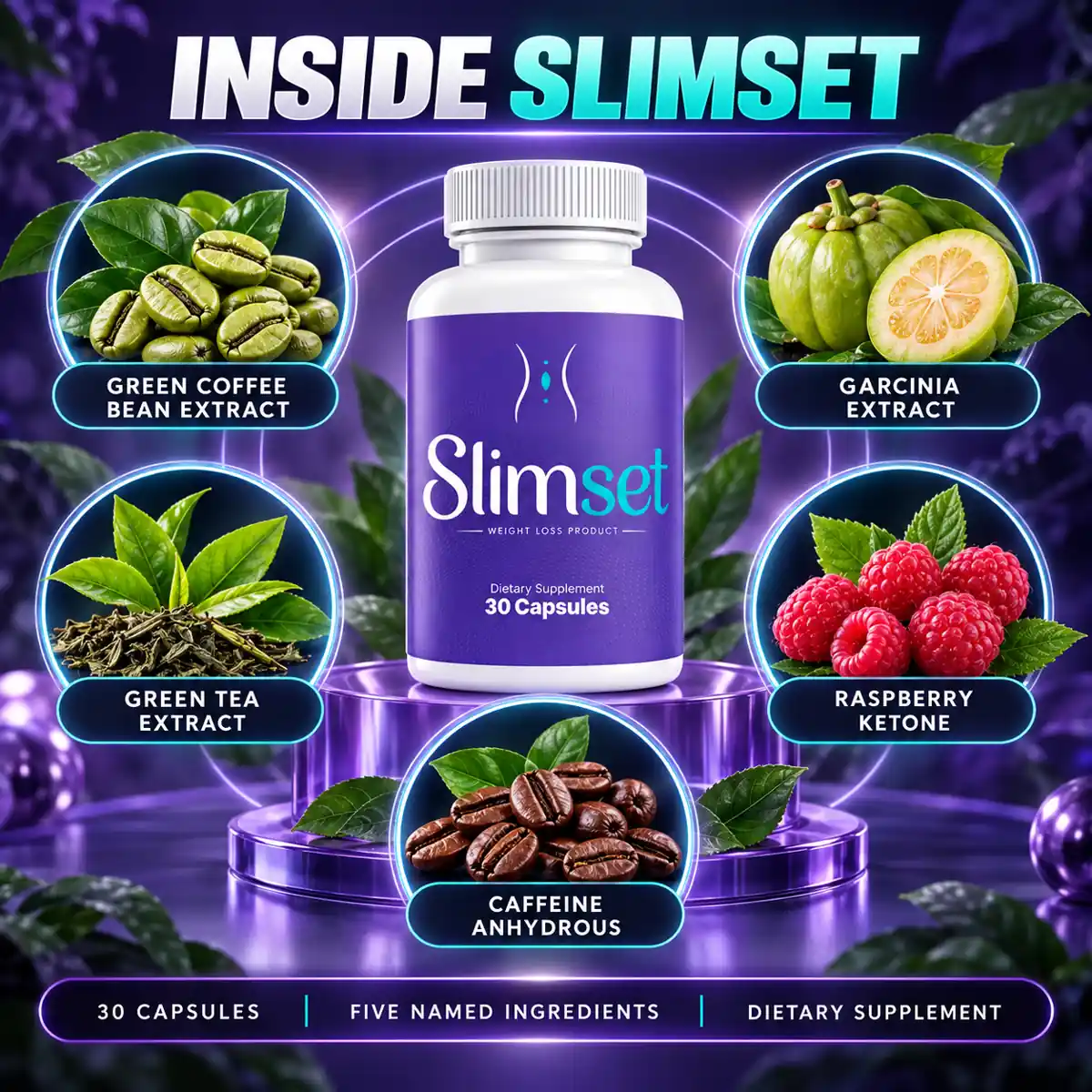
Five actives carry a printed milligram figure on the SlimSet panel, and none of them sits inside a proprietary blend.
Caffeine anhydrous leads at 138 mg. Green coffee bean, raspberry ketone, garcinia and green tea extract follow at 130 mg each. Applying the three standardisation percentages, 658 mg of extract resolves to about 456.5 mg of named compound.
Every name on the panel, what each one delivers once its percentage is applied, and the amount its own research used.
Which five names are printed on the SlimSet panel?
Five rows and five numbers, in the order the bottle sets them out.
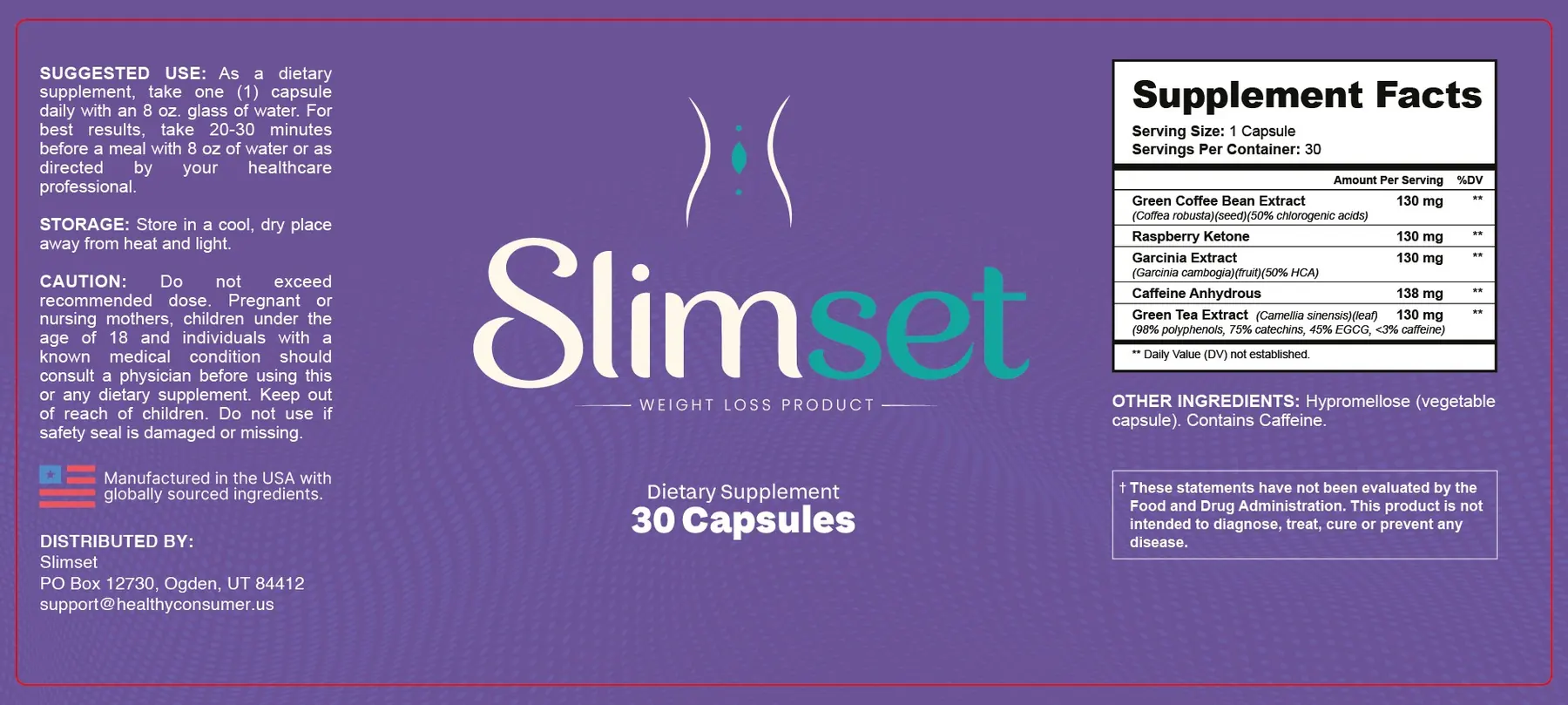
| Row, as the panel prints it | Per capsule | % Daily Value |
|---|---|---|
| Green Coffee Bean Extract (Coffea robusta) (seed) (50% chlorogenic acids) | 130 mg | † |
| Raspberry Ketone | 130 mg | † |
| Garcinia Extract (Garcinia cambogia) (fruit) (50% HCA) | 130 mg | † |
| Caffeine Anhydrous | 138 mg | † |
| Green Tea Extract (Camellia sinensis) (leaf) (98% polyphenols, 75% catechins, 45% EGCG, <3% caffeine) | 130 mg | † |
Serving size one capsule, thirty servings a container. Beneath the panel the label prints one inactive line, hypromellose (vegetable capsule), and then “Contains Caffeine.” on its own.
How much of each compound does a SlimSet capsule actually deliver?
Three of the five rows print a percentage. Here is what each one converts to.
An extract weight and a compound weight are two different quantities, and on this label three rows carry a percentage that converts one into the other. Applying those percentages is the single most useful piece of arithmetic anyone can do with this panel, and the label supplies every figure needed to do it.
| Row | Extract weight | What the label standardises it to | Compound delivered |
|---|---|---|---|
| Green Coffee Bean Extract | 130 mg | 50% chlorogenic acids | 65 mg chlorogenic acids |
| Raspberry Ketone | 130 mg | no percentage printed; a single compound | 130 mg raspberry ketone |
| Garcinia Extract | 130 mg | 50% HCA | 65 mg hydroxycitric acid |
| Caffeine Anhydrous | 138 mg | no percentage printed; a single compound | 138 mg caffeine |
| Green Tea Extract | 130 mg | 45% EGCG (of 75% catechins, 98% polyphenols) | 58.5 mg EGCG, inside 97.5 mg of catechins |
Two rows need no conversion: raspberry ketone and caffeine anhydrous are single compounds rather than plant extracts, so the extract weight is the compound weight. The green tea row prints three nested percentages, and the 45 per cent figure is the one that answers the EGCG question.
Add the right-hand column and 658 mg of declared extract resolves to about 456.5 mg of named compound. That is not a criticism: every milligram of the difference is plant material the extract legitimately contains, and a great many labels in this category never publish enough to let the sum be attempted.
It does change which number a reader should carry, though. When this panel is quoted as 658 mg of actives, that figure counts extract. When it is set against a trial, the trial almost always dosed the compound. The two columns above are the translation between them, and the rest of this page uses the right-hand one.
The green coffee row is standardised for chlorogenic acids and says nothing about its caffeine content, which unroasted robusta seed carries naturally. A survey of commercial green coffee extracts measured both compounds across the products on sale and found the caffeine figure varies widely between preparations. So the honest statement about this capsule’s caffeine is the printed 138 mg, plus under 3.9 mg from the green tea row, plus a small amount from this one that the label does not quantify.
What is each SlimSet ingredient, and what was it studied for?
Five actives, with the botany, the form and the literature attached to each.
In the panel’s own order, with the botany, the form and the research literature that attaches to each one.
Green Coffee Bean Extract
Coffea robusta, seed, 50% chlorogenic acids130 mgCoffee seed that has never been roasted. Roasting is what destroys most of the chlorogenic acids in a coffee bean, which is why an unroasted extract is the form this category uses. Robusta is named on the panel rather than the commoner arabica, and the two species differ in both acid and caffeine content.
The literature runs in two directions. The 2011 pooled analysis of weight trials reported a difference against placebo while judging every study it included at high risk of bias, and the trial that made the ingredient famous has since been recorded by PubMed as retracted. The cleaner work is elsewhere: a twelve-week blood pressure trial used 140 mg of chlorogenic acid a day, and an eight-week trial in metabolic syndrome used 400 mg of extract.
Raspberry Ketone
130 mgA single aroma compound, 4-(4-hydroxyphenyl)butan-2-one, responsible for the smell of a ripe raspberry and used as a flavouring long before anyone suggested it did anything else. Extracting it from fruit is uneconomic at supplement scale, so commercial material is generally synthesised; the label does not say which this is, and neither statement would change the compound.
Its reputation rests on a ten-week mouse-feeding experiment in which raspberry ketone made up half a per cent to two per cent of the animals’ entire diet. The one controlled human study tested a product containing several ingredients at once, so no result in it can be attributed to the ketone. This row is declared at a real figure and nothing more is claimed for it here.
Garcinia Extract
Garcinia cambogia, fruit, 50% HCA130 mgRind from a small Southeast Asian fruit, standardised to hydroxycitric acid, which is the compound every garcinia trial has measured. Sixty-five milligrams is what this row delivers.
This is the ingredient with the cleanest result in the whole category, and the result is negative. A 1998 randomised trial gave 135 people 1,500 mg of HCA a day for twelve weeks and could not separate them from placebo. The later pooled analysis found a small difference and called its clinical relevance uncertain. What the safety literature adds is set out on side effects, where it belongs rather than here.
Caffeine Anhydrous
138 mgCaffeine with the water removed, which makes it a fine powder that can be weighed into a capsule to the milligram. Chemically it is the same molecule a coffee delivers; the difference is that this one states its amount and a cup does not.
It is also the only row on this panel that arrives at a quantity the published research used. A 1989 study measured resting metabolic rate after 100 mg, and a dose-response study a year later ran 100, 200 and 400 mg and found the effect scaled with the amount given. At 138 mg this row sits inside that span, which is the honest positive on this label.
Green Tea Extract
Camellia sinensis, leaf, 98% polyphenols, 75% catechins, 45% EGCG, under 3% caffeine130 mgThe most heavily specified row here, and the only one on which a reader can calculate four separate quantities. Forty-five per cent of 130 mg is 58.5 mg of epigallocatechin gallate, sitting inside 97.5 mg of total catechins.
The thermogenesis work behind green tea used EGCG at 300 mg in a single dose and at 300 mg a day over a fortnight, roughly five times what this row delivers. The broader picture is cooler still: a Cochrane review of twelve and thirteen-week trials reported a mean difference of −0.04 kg outside Japan. The under-3-per-cent caffeine figure is the genuinely useful number on this row, because it bounds what the capsule can carry.
Which plant parts and species does SlimSet use?
Where the species and the plant part are printed, and where the question does not apply.
| Row | Species and part on this label | What the research used |
|---|---|---|
| Green coffee bean | Coffea robusta, seed | Mixed. Both robusta and arabica appear in the trial literature, and the acid and caffeine content differ between them. |
| Garcinia | Garcinia cambogia, fruit | Fruit rind, standardised to hydroxycitric acid. This row matches the research on species, part and marker compound. |
| Green tea | Camellia sinensis, leaf | Leaf, standardised to catechins. This row matches on species, part and marker as well. |
| Raspberry ketone | No species printed; a single compound | A compound rather than a plant preparation, so plant part does not arise. |
| Caffeine anhydrous | No species printed; a single compound | The same. Trial caffeine is dosed as the pure compound, exactly as here. |
Three of the five rows name a binomial and a plant part. Two are single compounds, for which a botanical source is not a meaningful field. Naming the species is more than a good deal of this category prints.
What do the SlimSet standardisation percentages mean?
Four kinds of number appear on this panel, and only one kind converts.
“50% chlorogenic acids” and “50% HCA”
A promise about concentration. Half of that 130 mg is the marker compound, so each of those two rows delivers 65 mg of the substance its trials measured. Both markers are the ones the published work used, which makes the comparison a fair one to attempt.
The green tea row’s three nested figures
Ninety-eight per cent polyphenols is the broadest band, seventy-five per cent catechins sits inside it, and forty-five per cent EGCG sits inside that. They are not additive, and reading them as three separate quantities is the commonest way this style of row gets misquoted.
“Under 3% caffeine”, which is a ceiling rather than a claim
The only upper bound on the entire panel. It caps what this row can add at about 3.9 mg, and it exists because a decaffeinated green tea extract and an ordinary one are different products at different prices. A buyer counting caffeine gets a usable number out of it.
The two rows with no percentage at all
Caffeine anhydrous and raspberry ketone are single compounds, so a percentage would have nothing to describe. Their printed weight is their compound weight, which is why the caffeine figure on this panel needs no translation before it is compared with anything.
Where do the SlimSet amounts and the trial amounts part company?
The compound column set against the amounts the published trials administered.
With the compound column in hand the comparison can be made properly, because the trials below dosed compound rather than extract. Sorted by how far apart the two figures sit.
| Compound delivered | What the published work used | How far apart |
|---|---|---|
| 138 mg caffeine | 100 mg raised resting metabolic rate over 150 minutes; 100, 200 and 400 mg gave a dose-dependent rise. | Inside the range. The one row where the label and the literature meet. |
| 130 mg raspberry ketone | No human amount has been published for the compound on its own. | Not comparable. There is nothing on the other side of the equation. |
| 65 mg chlorogenic acids | 140 mg a day for twelve weeks in the blood pressure trial; 400 mg of extract a day in the metabolic syndrome trial. | Under half, and against literature the pooled analysis judged at high risk of bias. |
| 58.5 mg EGCG | 300 mg of EGCG in both thermogenesis pilots. | About a fifth. |
| 65 mg hydroxycitric acid | 1,500 mg a day for twelve weeks in 135 people, which found nothing beyond placebo. | About four per cent of an amount that already failed. |
The middle column is what the trials administered. It is not a prediction about this capsule, and no row here should be read as one.
Of 456.5 mg of named compound in a SlimSet capsule, 138 mg is present at a quantity the research used and 318.5 mg is not. The remaining 130 mg has no published human quantity to be measured against at all. That sentence is the formula in one line, and it is only possible to write because this label prints every figure it needs.
What else is in a SlimSet capsule besides the five actives?
A one-line inactive declaration, which is shorter than this category usually manages.
One line, and it is the shell: hypromellose (vegetable capsule). Nothing else is declared, and the label then prints “Contains Caffeine.” on a line of its own.
Hypromellose, the shell
Hydroxypropyl methylcellulose, made from plant cellulose, and the standard vegetarian alternative to a gelatin capsule. It is tasteless, it keeps a dry powder dry, and it settles the question some buyers need answered before anything else: there is nothing animal-derived in this product.
No filler, and what that tells you
Most capsules of this size carry rice flour, magnesium stearate or silica to bulk and flow the powder. This one declares none. At 658 mg of extract the capsule is close to full at a standard size, which is the ordinary reason a formula needs no bulking agent.
The caffeine line, printed twice
Caffeine anhydrous appears on the panel as a row and again under the other-ingredients line as an allergen-style statement. That is the label naming its own stimulant in the place a buyer scanning for warnings will look, and it is the right way round.
What is not on the label at all
No sweetener, no flavouring, no colour and no preservative are declared. A capsule does not need them the way a gummy or a powder does, and the short list is one reason the panel arithmetic above comes out cleanly.
SlimSet ingredient questions
How many ingredients are in SlimSet?
Five actives, each with its own row and its own milligram figure, plus one inactive line: hypromellose (vegetable capsule). There is no proprietary blend, so every quantity on the panel can be read directly.
How much caffeine does the whole capsule carry?
138 mg is printed as caffeine anhydrous. The green tea row is capped at under 3 per cent caffeine, so it adds under 3.9 mg, and the green coffee row adds a small amount the label does not quantify. Treat the total as 138 mg plus single-digit milligrams.
What does “50% HCA” actually deliver?
Sixty-five milligrams of hydroxycitric acid, from 130 mg of garcinia extract. The trials that measured HCA used 1,500 mg a day.
How much EGCG is in one capsule?
58.5 mg, being 45 per cent of the 130 mg green tea row. The two thermogenesis pilots used 300 mg.
Is SlimSet vegetarian?
The shell is hypromellose, which is plant cellulose, and it is the only inactive ingredient declared. Nothing on the panel is animal-derived.
Is the raspberry ketone from raspberries?
The label does not say. Fruit extraction is uneconomic at this scale, so commercial raspberry ketone is generally synthesised, and the compound is identical either way.
Which row is the largest?
Caffeine anhydrous at 138 mg. The other four are 130 mg each, which is why 658 mg is such a round total.
Sources for the SlimSet ingredient list
Every study named above, grouped by the panel row it belongs to.
- Onakpoya I, Terry R, Ernst E. The use of green coffee extract as a weight loss supplement: a systematic review and meta-analysis of randomised clinical trials. Gastroenterol Res Pract. 2011;2011:382852. PMID 20871849. https://pubmed.ncbi.nlm.nih.gov/20871849/
- Vinson JA, Chen X, Garver DD. Determination of Total Chlorogenic Acids in Commercial Green Coffee Extracts. J Med Food. 2019;22(3):314-320. PMID 30888913. https://pubmed.ncbi.nlm.nih.gov/30888913/
- Watanabe T, Arai Y, Mitsui Y, et al. The blood pressure-lowering effect and safety of chlorogenic acid from green coffee bean extract in essential hypertension. Clin Exp Hypertens. 2006;28(5):439-49. PMID 16820341. https://pubmed.ncbi.nlm.nih.gov/16820341/
- Roshan H, Nikpayam O, Sedaghat M, Sohrab G. Effects of green coffee extract supplementation on anthropometric indices, glycaemic control, blood pressure, lipid profile, insulin resistance and appetite in patients with the metabolic syndrome: a randomised clinical trial. Br J Nutr. 2018;119(3):250-258. PMID 29307310. https://pubmed.ncbi.nlm.nih.gov/29307310/
- Heymsfield SB, Allison DB, Vasselli JR, et al. Garcinia cambogia (hydroxycitric acid) as a potential antiobesity agent: a randomized controlled trial. JAMA. 1998;280(18):1596-600. PMID 9820262. https://pubmed.ncbi.nlm.nih.gov/9820262/
- Onakpoya I, Hung SK, Perry R, Wider B, Ernst E. The Use of Garcinia Extract (Hydroxycitric Acid) as a Weight loss Supplement: A Systematic Review and Meta-Analysis of Randomised Clinical Trials. J Obes. 2011;2011:509038. PMID 21197150. https://pubmed.ncbi.nlm.nih.gov/21197150/
- Jurgens TM, Whelan AM, Killian L, Doucette S, Kirk S, Foy E. Green tea for weight loss and weight maintenance in overweight or obese adults. Cochrane Database Syst Rev. 2012;12(12):CD008650. PMID 23235664. https://pubmed.ncbi.nlm.nih.gov/23235664/
- Boschmann M, Thielecke F. The effects of epigallocatechin-3-gallate on thermogenesis and fat oxidation in obese men: a pilot study. J Am Coll Nutr. 2007;26(4):389S-395S. PMID 17906192. https://pubmed.ncbi.nlm.nih.gov/17906192/
- Thielecke F, Rahn G, Bohnke J, et al. Epigallocatechin-3-gallate and postprandial fat oxidation in overweight/obese male volunteers: a pilot study. Eur J Clin Nutr. 2010;64(7):704-13. PMID 20372175. https://pubmed.ncbi.nlm.nih.gov/20372175/
- Morimoto C, Satoh Y, Hara M, Inoue S, Tsujita T, Okuda H. Anti-obese action of raspberry ketone. Life Sci. 2005;77(2):194-204. PMID 15862604. https://pubmed.ncbi.nlm.nih.gov/15862604/
- Arent SM, Walker AJ, Pellegrino JK, et al. The Combined Effects of Exercise, Diet, and a Multi-Ingredient Dietary Supplement on Body Composition and Adipokine Changes in Overweight Adults. J Am Coll Nutr. 2018;37(2):111-120. PMID 29111889. https://pubmed.ncbi.nlm.nih.gov/29111889/
- Dulloo AG, Geissler CA, Horton T, Collins A, Miller DS. Normal caffeine consumption: influence on thermogenesis and daily energy expenditure in lean and postobese human volunteers. Am J Clin Nutr. 1989;49(1):44-50. PMID 2912010. https://pubmed.ncbi.nlm.nih.gov/2912010/
- Astrup A, Toubro S, Cannon S, Hein P, Breum L, Madsen J. Caffeine: a double-blind, placebo-controlled study of its thermogenic, metabolic, and cardiovascular effects in healthy volunteers. Am J Clin Nutr. 1990;51(5):759-67. PMID 2333832. https://pubmed.ncbi.nlm.nih.gov/2333832/
Order SlimSet with all five figures in front of you
Five actives, five printed amounts, 30 capsules a bottle and 60 days from the date of purchase to change your mind.
One bottle $89 · six bottles $294 · 60-day money-back guarantee
Order SlimSet On The Official WebsiteOne capsule a day · 30 per bottle · lot SLI-26/GE-8193