SlimSet Official Website › Blog › The 8 oz Glass Of Water
8 oz Of Water: What The Water-Before-Meals Trials Actually Used
The suggested-use line on the bottle asks for an 8 oz glass of water with the capsule, and it asks for it twice in one sentence. Most of the research on drinking water before meals used about twice that volume. Neither fact is a problem on its own, but the two should not be blurred together, because one of them has trials behind it and the other does not.
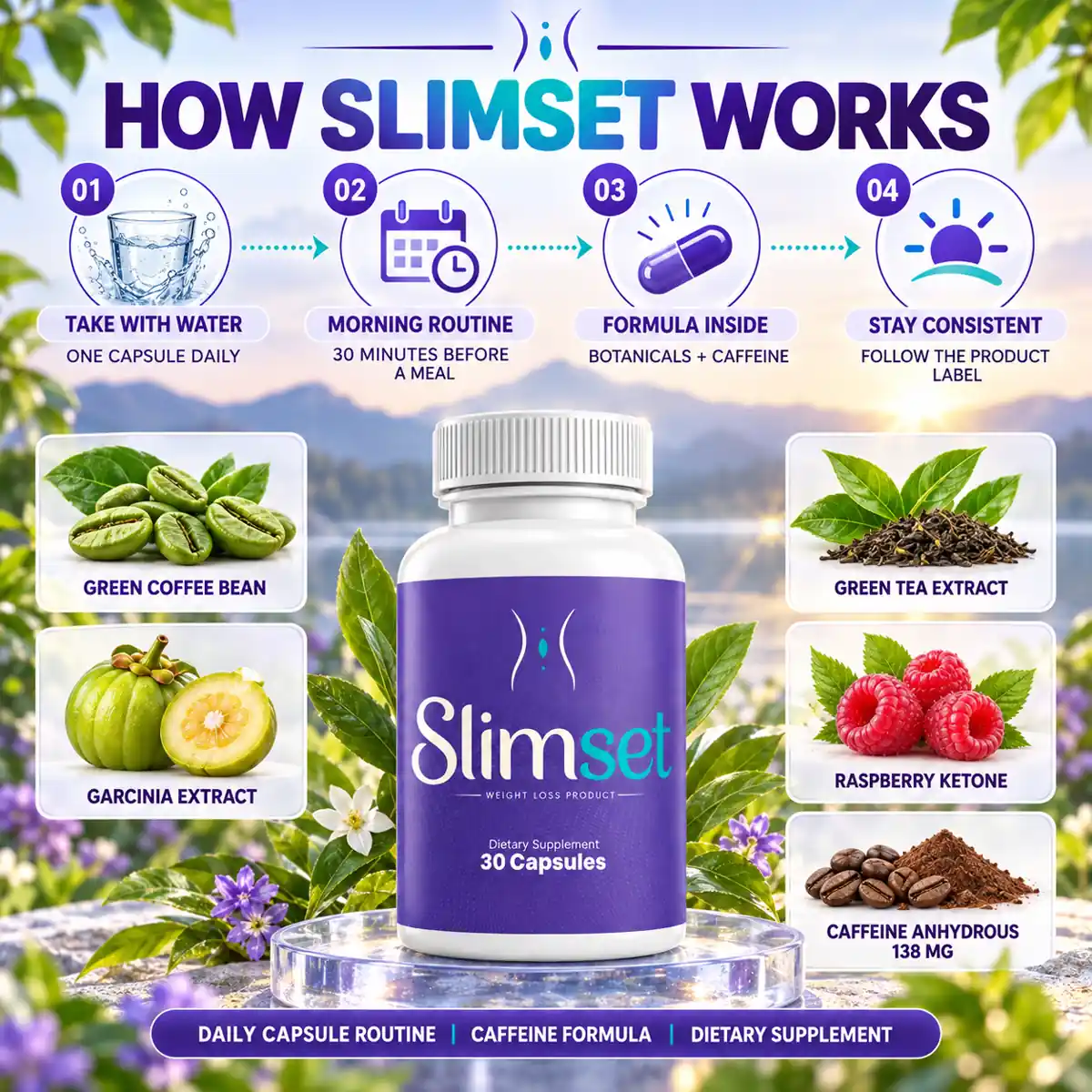
- The label asks for one capsule with an 8 oz glass of water, 20 to 30 minutes before a meal. It prints the glass twice.
- 8 US fluid ounces is about 237 ml. The two water-preload trials read here gave 500 ml, roughly 2.1 times as much.
- The Birmingham trial found 1.3 kg more weight lost at 12 weeks; once adjusted, the confidence interval reached zero.
- The older-adults trial found about 2 kg more at 12 weeks, alongside a hypocaloric diet. Its meal-size effect had faded by week 12.
- The idea that water burns calories was reassessed and did not hold up at room temperature.
What the bottle actually asks for
Read the suggested-use sentence slowly and it turns out to be five instructions folded into one. Take one capsule a day. Take it with an 8 oz glass of water. For best results, take it 20 to 30 minutes before a meal. Take it with 8 oz of water, again. And do it as directed by your healthcare professional. The glass is in there twice, which is a fair signal of how much the label wants it.
The label does not say why, and nothing on it claims the water does anything else. The how to use page takes the sentence apart clause by clause, and its reading is sensible: a full glass rather than a sip, enough to get the capsule down and to disperse the powder once the shell opens.
That restraint is worth noticing, because there is a whole body of weight-loss folklore built around water, and a reader who has heard it could easily assume the glass on the label is part of the mechanism. It might be worth asking whether it is. So this article goes and reads what was actually measured when people were asked to drink water before eating, and then holds the result up against the glass this bottle asks for.
8 oz against 500 ml, done properly
Start with the arithmetic, because the units hide it. A US fluid ounce is 29.57 ml, so the label’s 8 oz glass is 236.6 ml, call it 237. The water-preload trials do not use ounces. They use 500 ml, which is 16.9 US fluid ounces. Divide one by the other and the trial preload comes out at about 2.1 glasses of the size this label asks for.
| Measure | The label | The preload trials |
|---|---|---|
| Volume of water | 8 oz, about 237 ml | 500 ml, about 16.9 oz |
| How often | Once a day, with the capsule | Before main meals, plural, so at least twice a day |
| Timing | 20 to 30 minutes before a meal | 30 minutes before main meals in the Birmingham trial |
| Daily water this adds | About 237 ml | At least 1,000 ml if two main meals, more if three |
| What else was going on | A capsule with five active rows | A hypocaloric diet in one trial, a weight-management consultation in the other |
The daily-total row is arithmetic from the trial descriptions, which say “main meals” in the plural. Nothing here is a published figure for this bottle.
None of that makes the label’s glass wrong. A glass of water with a capsule is entirely reasonable and nobody was ever going to ask for a litre. The point is narrower: when the water-preload literature is quoted next to a supplement, it is the trial intervention being quoted, and the trial intervention is about four to six times more water per day than one glass with a capsule. What follows is what that larger intervention found.
The two trials behind the idea
Two randomised trials do most of the work, and both are small. Both are also fairly honest about what they did and did not show.
The first was run by Dennis and colleagues in middle-aged and older adults, aged 55 to 75, with a body mass index between 25 and 40. Forty-eight of them were assigned to one of two arms for 12 weeks: a hypocaloric diet plus 500 ml of water before each daily meal, or the same diet alone. Weight was measured weekly. The water group lost about 2 kg more than the diet-only group, and the paper describes its rate of decline as 44 per cent greater over the 12 weeks.
The second was run by Parretti and colleagues in general practices in Birmingham, England. Eighty-four adults with obesity all received a 30-minute weight-management consultation and a 10-minute follow-up call at two weeks. One arm was then asked to drink 500 ml of water 30 minutes before their main meals. The comparison arm was an attention control: they were asked to imagine their stomach was full before meals. At 12 weeks the water group had lost 1.3 kg more than the comparison group, with a 95 per cent confidence interval of 0.1 to 2.4 kg, and a P value of 0.028.
Then comes the part that tends not to survive quotation. After the authors adjusted for ethnicity, deprivation, age and gender, the difference became 1.2 kg with an interval running from 2.4 kg down to a 0.07 kg gain, and a P value of 0.063. The lower edge of the interval crossed zero. The authors’ own conclusion was measured: “preliminary evidence” of a moderate weight loss at follow-up. That is the honest size of it. Two decent trials, 132 people between them, 12 weeks each, pointing the same way, one of them less certain once the sums were adjusted.
Everyone in both trials was also being helped to change how they ate. One arm followed a hypocaloric diet; the other arms in the Birmingham trial got a consultation and a follow-up call. Water was the difference between arms, not the whole intervention, and neither trial tested a capsule of any kind.
What happened to the meal itself
The plausible mechanism for a preload is not exotic. Fill part of the stomach with something that has no calories and you might eat a bit less when the food arrives. The older-adults trial measured exactly that, which is what makes it more useful than a bare weight figure.
At the start of the study each person ate an ad libitum test meal twice, once with no preload and once after 500 ml of water. Before any dieting, the water lowered energy intake at the meal from 541 kcal to 498 kcal. That is 43 kcal, or about 8 per cent, and the P value was 0.009. So the acute effect was real, if modest.
Twelve weeks later the same test was repeated. Now the gap was 506 kcal without water against 480 kcal with it. That is 26 kcal, about 5 per cent, and the P value was 0.069. The paper reports that the ability of the preload to reduce meal intake was not sustained at 12 weeks. The trial still found the water group had lost more weight overall, so the authors suggest the effect may be “due in part” to the acute reduction at meals. In part is a careful phrase, and it is the right one.
Forty-three kcal is not nothing across several meals and twelve weeks, and it is also not a large number to build a product story on. It has one further consequence worth stating plainly: whatever a glass of water does at a meal, the evidence says its effect on how much you eat appears to shrink with familiarity.
The thermogenesis story, reassessed
The other claim that follows water around is that drinking it speeds up the body’s energy use, so that the water itself burns calories. It is worth covering because it is the version most likely to be attached to a fat-metabolism supplement, and because the record is unusually tidy.
The 2003 study by Boschmann and colleagues measured 14 healthy, normal-weight volunteers in a whole-room calorimeter. After 500 ml of water their metabolic rate rose by 30 per cent, starting within 10 minutes and peaking at 30 to 40. The total extra energy was about 100 kJ, which is around 24 kcal. About 40 per cent of the effect was put down to the body warming the water from 22 to 37 degrees. The authors extrapolated that two litres a day would add about 400 kJ, or roughly 96 kcal, and suggested it be considered in weight-loss programmes.
Three years later Brown, Dulloo and Montani tried to reproduce it in a randomised crossover. Young volunteers drank about 518 ml of distilled water, or saline, or a sucrose solution as a positive control. Energy expenditure did not rise after the water or the saline. It rose clearly after sucrose, so the method could detect a real effect. Water chilled to 3 degrees produced a small rise of 4.5 per cent over 60 minutes, which is well below the energy it would take to warm it. The authors’ conclusion was that the results cast doubt on water as a thermogenic agent.
A 2015 reassessment by Charrière and colleagues then measured 27 healthy young adults across a wide range of body weight, with a proper sham-drinking control. Resting energy expenditure after 500 ml of room-temperature distilled water rose by less than 3 per cent, and that was not different from the sham drink. The respiratory quotient, which is the marker for the fuel being burned, fell after the water, and it fell just as far after the sham drink, so the water was not what moved it. Their reading: ingesting purified water does not by itself stimulate thermogenesis or fat oxidation.
So one striking result, two attempts that could not repeat it, and a reassessment with a control that explains why it looked real the first time. That is the normal, healthy life cycle of a surprising finding, and it is the reason the calorie-burning explanation should be left off any sentence about the glass of water on this label. What is left standing is the modest meal-size effect above, in trials that also included diet advice.
Does the caffeine make the glass a fix?
There is one more reason a reader might expect the water to matter. The capsule carries 138 mg of caffeine anhydrous, and caffeine has a reputation as a dehydrating agent, which would turn the glass into damage control. The reputation is older than the evidence for it.
A 2014 crossover trial put 50 men who habitually drank three to six cups of coffee a day through two three-day trials. In one they drank four 200 ml servings of coffee containing 4 mg/kg of caffeine; in the other, the same volume of water. Total body water, measured with deuterium oxide, was 51.5 kg after coffee and 51.4 kg after water. Twenty-four hour urine output was 2,409 ml against 2,428 ml. The paper looked across a wide range of blood and urine markers and found no meaningful difference, and concluded that in these men moderate coffee provided similar hydrating qualities to water.
The limits are as plain as the result. The volunteers were men, they were habitual coffee drinkers, they drank a beverage rather than swallowing a capsule, and the study says nothing about a person who rarely takes caffeine. Read fairly, it removes one worry rather than adding a claim. There is no good reason to think the glass is there to make up for a 138 mg dose, and no evidence that the dose needs making up for in a habitual drinker.
What this means for the glass on the label
Put the pieces on one table and the position is clear enough to state without decoration.
| Question | What the record says | Does it apply to the 8 oz on the label? |
|---|---|---|
| Does water before a meal lower meal size? | 43 kcal at baseline in older adults; 26 kcal and no longer clear by 12 weeks | Tested at 500 ml, not 237 ml |
| Does it add to weight lost on a diet? | About 2 kg more and 1.3 kg more at 12 weeks, the latter less certain once adjusted | Tested before main meals with diet help, not once a day with a capsule |
| Does it burn calories? | One positive result; two attempts to repeat it found nothing at room temperature | No |
| Does caffeine make it necessary for hydration? | No difference from water in 50 habitual coffee drinkers | Different form, but no sign it is needed |
The reading that survives is unglamorous and perfectly good: the glass on the label is a glass for swallowing a capsule. It is a sensible thing to do, and it costs nothing. It is not the tested water-preload intervention, and no page on this website will say it is. If it happens to make you feel a little fuller before breakfast, that is a pleasant side effect and a personal observation rather than a finding, and it is not something to credit to the capsule.
The same goes in the other direction. If somebody tells you the water is what makes the product work, they are borrowing two trials that used twice the volume, more than once a day, with diet help, and neither of which had a capsule in it. The article on the caffeine row covers the one ingredient on this panel that has a measured effect of its own, and it does so without any help from the glass.
If you want to test water on its own
The interesting practical point is that the water-preload idea is one of the few in this whole area that you can test on yourself for nothing, separately from any capsule. That is also the fair way to do it, because a single change is the only kind you can attribute.
- Decide which experiment you are running. Water before meals is one. The capsule is another. Starting both on the same morning means neither can be read.
- If you try the preload, note what the trials did: a defined volume (500 ml), a defined gap (about 30 minutes), before main meals, for 12 weeks. A vague glass now and then is not that experiment.
- Write down what you eat at the meal that follows, not just what the scale says at the end of the fortnight. The meal is where the trial effect lived.
- Expect the effect on meal size to be small and to fade, because that is what the only trial that measured it found.
Then, separately, use the capsule the way the label asks. The how to use page has the caffeine ledger for the day it goes into, and the side effects page covers what to expect from the caffeine itself. The results timeline sets out how to keep a log across the 60-day guarantee window, which is the one clock on this product that carries a consequence.
A dietary supplement for healthy adults of 18 and over, not a medicine and not FDA-approved. The bottle’s only descriptors are the category line under the wordmark, “Dietary Supplement” and “30 Capsules”. Nothing in this article says that water, or the capsule, causes weight loss; it reads two small trials of water taken before meals and says what they used.
References
- Dennis EA, Dengo AL, Comber DL, Flack KD, Savla J, Davy KP, Davy BM. Water consumption increases weight loss during a hypocaloric diet intervention in middle-aged and older adults. Obesity (Silver Spring). 2010;18(2):300-7. PMID 19661958. https://pubmed.ncbi.nlm.nih.gov/19661958/
- Parretti HM, Aveyard P, Blannin A, Clifford SJ, Coleman SJ, Roalfe A, et al. Efficacy of water preloading before main meals as a strategy for weight loss in primary care patients with obesity: RCT. Obesity (Silver Spring). 2015;23(9):1785-91. PMID 26237305. https://pubmed.ncbi.nlm.nih.gov/26237305/
- Boschmann M, Steiniger J, Hille U, Tank J, Adams F, Sharma AM, et al. Water-induced thermogenesis. J Clin Endocrinol Metab. 2003;88(12):6015-9. PMID 14671205. https://pubmed.ncbi.nlm.nih.gov/14671205/
- Brown CM, Dulloo AG, Montani JP. Water-induced thermogenesis reconsidered: the effects of osmolality and water temperature on energy expenditure after drinking. J Clin Endocrinol Metab. 2006;91(9):3598-602. PMID 16822824. https://pubmed.ncbi.nlm.nih.gov/16822824/
- Charrière N, Miles-Chan JL, Montani JP, Dulloo AG. Water-induced thermogenesis and fat oxidation: a reassessment. Nutr Diabetes. 2015;5(12):e190. PMID 26690288. https://pubmed.ncbi.nlm.nih.gov/26690288/
- Killer SC, Blannin AK, Jeukendrup AE. No evidence of dehydration with moderate daily coffee intake: a counterbalanced cross-over study in a free-living population. PLoS One. 2014;9(1):e84154. PMID 24416202. https://pubmed.ncbi.nlm.nih.gov/24416202/
- SlimSet product label artwork, supplied in the vendor asset pack. Suggested use: one capsule daily with an 8 oz glass of water, 20 to 30 minutes before a meal. Serving size one capsule, 30 per container.