SlimSet Official Website › Blog › HCA And The Garcinia Trials
65 mg Of HCA: What The Garcinia Weight-Loss Trials Actually Used
Garcinia is the row on this panel with the cleanest efficacy trials of the five, which is exactly why it is worth reading carefully. A 2011 meta-analysis pooled the randomised trials and found a real, if small, result. The trials behind that result gave subjects far more hydroxycitric acid a day than a 130 mg row standardised to 50% can supply.
- A 2011 systematic review and meta-analysis pooled nine trials and found a mean weight difference of −0.88 kg favouring HCA over placebo.
- The review’s own authors called the effect small and its clinical relevance uncertain.
- Individual trials in this literature gave subjects 1,200 to 2,800 mg of HCA a day.
- This panel’s garcinia row, 130 mg at 50% HCA, supplies about 65 mg — roughly a twentieth of the smaller trial doses.
- Gastrointestinal side effects were reported about twice as often in the HCA group as in placebo in the pooled data.
What hydroxycitric acid is supposed to do
Hydroxycitric acid, HCA, is the compound garcinia cambogia is extracted and standardised for. The proposed mechanism is a competitive inhibition of ATP-citrate lyase, an enzyme involved early in the pathway the body uses to turn excess carbohydrate into stored fat. Block the enzyme, the theory runs, and less of what you eat ends up as new fat, and more of it may be burned instead.
That is a real enzyme with a real, published mechanism, and it separates garcinia from ingredients whose proposed action is vaguer. A plausible mechanism is not the same thing as a proven effect at a stated dose, and the distance between those two claims is what the rest of this article is about.
The 2011 meta-analysis, read in full
A systematic review and meta-analysis published in the Journal of Obesity is the single most useful document on this ingredient. The authors identified twenty-three eligible trials, included twelve after a quality screen, and pooled nine of those for a formal meta-analysis.
The pooled result: a mean difference of −0.88 kg (95% CI: −1.75 to −0.00) favouring HCA over placebo. That confidence interval sits right at the edge of zero, which is a polite way of saying the result is real but not by much. The authors’ own conclusion is worth quoting rather than summarising: the magnitude of the effect is small, and the clinical relevance is uncertain.
That sentence, from the people who ran the analysis, is a more honest verdict than most retail copy for this ingredient offers. It is also the correct starting point for everything that follows, because a small pooled effect built from a range of doses is not the same claim as an effect at any one dose, including the one on this label.
Three trials, read for their actual doses
A meta-analysis reports an average across trials that did not all use the same amount of HCA. Reading the individual trials the review draws on is the only way to see what doses actually produced results, and what doses did not.
| The trial | HCA given, per day | Duration | What it found |
|---|---|---|---|
| Vasques 2014, randomised, placebo-controlled | About 1,200 mg (2.4 g of a 50% extract) | 60 days | Triglycerides fell; weight, BMI, waist-hip ratio and fat mass did not change significantly |
| Vasques 2008, randomised, placebo-controlled | About 1,257 mg (2.4 g of a 52.4% extract), plus konjac fibre | 12 weeks | Total cholesterol and LDL fell; weight, resting energy expenditure and triglycerides did not change significantly |
| Preuss 2004, randomised, placebo-controlled | 2,800 mg (a proprietary HCA-SX salt form) | 8 weeks | Body weight down 5.4%, BMI down 5.2%, alongside reduced food intake and cholesterol |
All three doses are the trial’s own reported amount of HCA, not the raw weight of garcinia extract, so they can be compared directly with the 65 mg figure below.
Two of those three trials, at HCA doses of roughly 1,200 and 1,257 mg a day, found no significant change in body weight at all — only in blood lipids. The one trial that reported a meaningful weight result used 2,800 mg a day, more than double the other two, and a proprietary delivery form its own authors describe as having superior bioavailability.
The one trial with the biggest number, and who ran it
The 2004 trial deserves a second look, because it is the outlier and outliers are where a careful reader should slow down. The HCA in that trial was not plain garcinia extract; it was a calcium-potassium salt form the paper calls HCA-SX, sold under the brand name Super CitriMax, and several of the paper’s authors are affiliated with the company that manufactures it.
That does not make the finding false. It does mean the 5.4% weight result belongs to a specific, patented formulation dosed at 2,800 mg a day and taken 30 to 60 minutes before each of three meals — a detail that happens to echo this bottle’s own before-meal instruction, though the dose does not. A study funded and partly authored by the company selling the ingredient it tested is not automatically wrong, but it carries a conflict of interest a reader is entitled to know about before weighing the number.
Strip that trial out and the two independent university trials above, at roughly 1,200–1,257 mg a day, moved cholesterol and triglycerides but not body weight. That is a materially different picture from the 5.4% figure alone, and it is the picture the 2011 meta-analysis’s own modest −0.88 kg result is consistent with.
See every row on this panel converted the same way
Three of the five rows print a standardisation, so three of the five can be carried through to the compound the research studied. The supplement facts page does all of them and sets each beside its trial dose.
One bottle $89 · six bottles $294 · 60-day money-back guarantee
Order SlimSet On The Official WebsiteOne capsule a day · 30 per bottle · lot SLI-26/GE-8193
What a 130 mg row at 50% delivers
This is arithmetic, not opinion. The panel prints Garcinia Extract at 130 mg, bracketed to 50% HCA. Half of 130 is 65. One capsule delivers about 65 mg of hydroxycitric acid a day.
| This panel | The trial range above | |
|---|---|---|
| Garcinia extract printed | 130 mg | — |
| Standardisation printed | 50% HCA | — |
| HCA delivered | about 65 mg a day | 1,200 to 2,800 mg a day |
| Capsules that would reach the lower trial dose | Roughly eighteen a day | One day’s dose |
| What the pooled meta-analysis found | — | −0.88 kg against placebo |
The left column is this label’s own printed figures, carried through its own percentage. The right column is what the cited trials actually gave their subjects.
The gap, expressed honestly
Sixty-five milligrams against a trial range of 1,200 to 2,800 milligrams is a gap of roughly eighteen to forty-three times, depending which trial in the table above is the comparison. That is a wide range to quote as a single number, so it is worth being explicit: this is an illustrative comparison built from the exact doses the three cited trials used, not a single official threshold the way the chlorogenic acid literature has one. No trial has tested a 65 mg dose of HCA in isolation, so no study can say what, if anything, that specific amount does on its own.
What can be said is narrower and more useful. The meta-analysis that found a real, if small, pooled effect was built from trials clustered several multiples above this row. Nothing about that pooled result predicts what a dose an order of magnitude smaller does, in either direction.
The side of the ledger marketing pages skip
The 2011 meta-analysis reported one more figure worth carrying forward: in the trial that recorded adverse events in enough detail to compare, gastrointestinal side effects were about twice as common in the HCA group as in the placebo group. That is not a dramatic finding and it is not a reason to avoid the ingredient. It is a reason to treat garcinia the way the review’s authors did — as a compound with a small, real effect and a small, real cost, rather than as either a miracle or a placebo.
- The pooled weight result is real, small, and rests on a confidence interval that nearly touches zero.
- The trial with the largest reported effect used more than double the HCA of the two independent trials, in a patented salt form, with the manufacturer among the authors.
- Gastrointestinal adverse events were about twice as frequent with HCA as with placebo in the pooled data.
- No cited trial tested anything close to this label’s 65 mg amount on its own.
The liver question, briefly, and where the full answer lives
Garcinia carries a separate published case literature on liver injury, distinct from the efficacy question this article covers. This site has already written that safety review in full, with the case reports, the genetic susceptibility research, and the symptoms worth knowing before the first capsule — see Green Tea Extract And The Liver: Who Should Pause First, which covers garcinia’s case reports as its second half. This article stays on the efficacy question: what the weight-loss trials used, and what this row actually supplies.
What this means at a shelf
- Find the standardisation. A garcinia row with no HCA percentage cannot be evaluated at all.
- Do the sum: percentage times milligrams equals the HCA the trials actually studied.
- Compare that figure against a trial range of roughly 1,200 to 2,800 mg a day, not a single number.
- Note who funded any single trial being cited, especially an unusually large reported effect.
- Treat a pooled −0.88 kg result as what it is: real, small, and built from doses well above most capsules.
Applied to this bottle specifically: the row is printed, the percentage is printed, the sum comes to about 65 mg, and 65 mg sits well below every dose in the cited trials. That does not mean the ingredient does nothing at this amount — nobody has tested this amount in isolation to say either way. It means the published efficacy evidence for garcinia was built at doses this capsule does not carry, and a fair label reading says so rather than borrowing the trial’s result for a different number.
A dietary supplement for healthy adults of 18 and over, not a medicine and not FDA-approved. The bottle prints no specific weight-loss guarantee, and its own caution rules out anyone pregnant or nursing, anyone under 18, and anyone with a known medical condition who has not raised it with a clinician first. Nothing in this article changes that ceiling in either direction.
References
- Onakpoya I, Hung SK, Perry R, Wider B, Ernst E. The Use of Garcinia Extract (Hydroxycitric Acid) as a Weight Loss Supplement: A Systematic Review and Meta-Analysis of Randomised Clinical Trials. J Obes. 2011;2011:509038. PMID 21197150. https://pubmed.ncbi.nlm.nih.gov/21197150/
- Vasques CA, Schneider R, Klein-Júnior LC, Falavigna A, Piazza I, Rossetto S. Hypolipemic effect of Garcinia cambogia in obese women. Phytother Res. 2014;28(6):887-91. PMID 24133059. https://pubmed.ncbi.nlm.nih.gov/24133059/
- Vasques CA, Rossetto S, Halmenschlager G, Linden R, Heckler E, Fernandez MS, Alonso JL. Evaluation of the pharmacotherapeutic efficacy of Garcinia cambogia plus Amorphophallus konjac for the treatment of obesity. Phytother Res. 2008;22(9):1135-40. PMID 18729243. https://pubmed.ncbi.nlm.nih.gov/18729243/
- Preuss HG, Rao CV, Garis R, Bramble JD, Ohia SE, Bagchi M, Bagchi D. An overview of the safety and efficacy of a novel, natural(−)-hydroxycitric acid extract (HCA-SX) for weight management. J Med. 2004;35(1-6):33-48. PMID 18084863. https://pubmed.ncbi.nlm.nih.gov/18084863/
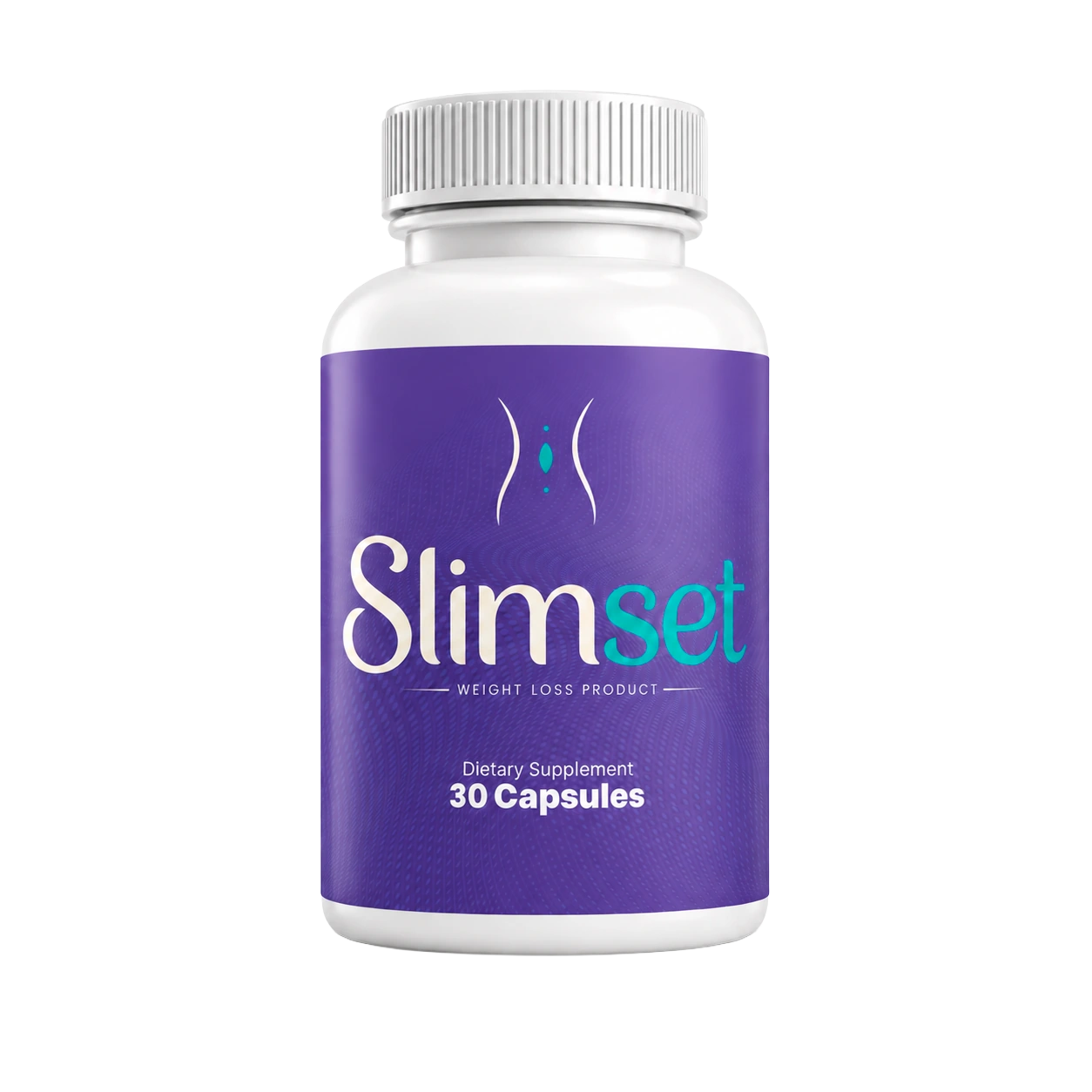
- SlimSet product label artwork, supplied in the vendor asset pack. Serving size one capsule, 30 per container. Distributed by Slimset, PO Box 12730, Ogden, UT 84412.