SlimSet Official Website › Blog › Are Weight-Loss Supplements Safe
Are Weight-Loss Supplements Safe? What The Emergency-Room Data Say
It is one of the most common questions asked about anything sold in this category, and it cannot be answered as asked. “Weight-loss supplements” is a shelf, not a substance. What can be answered is narrower and more useful: what the public safety data show about the shelf, what they are silent about, and which parts of it apply to a bottle whose panel prints a milligram figure against every row.
- A US surveillance study estimated about 23,000 emergency visits a year from supplement adverse events, from 3,667 cases in 63 hospitals over 2004 to 2013.
- Weight-loss and energy products caused 71.8% of the supplement-related events involving palpitations, chest pain or a fast heartbeat.
- The study counts visits, not users, and does not name products, so it cannot rank one bottle against another.
- Two product analyses found label mismatches, including undeclared stimulants in some products and caffeine capsules far off their labelled amount.
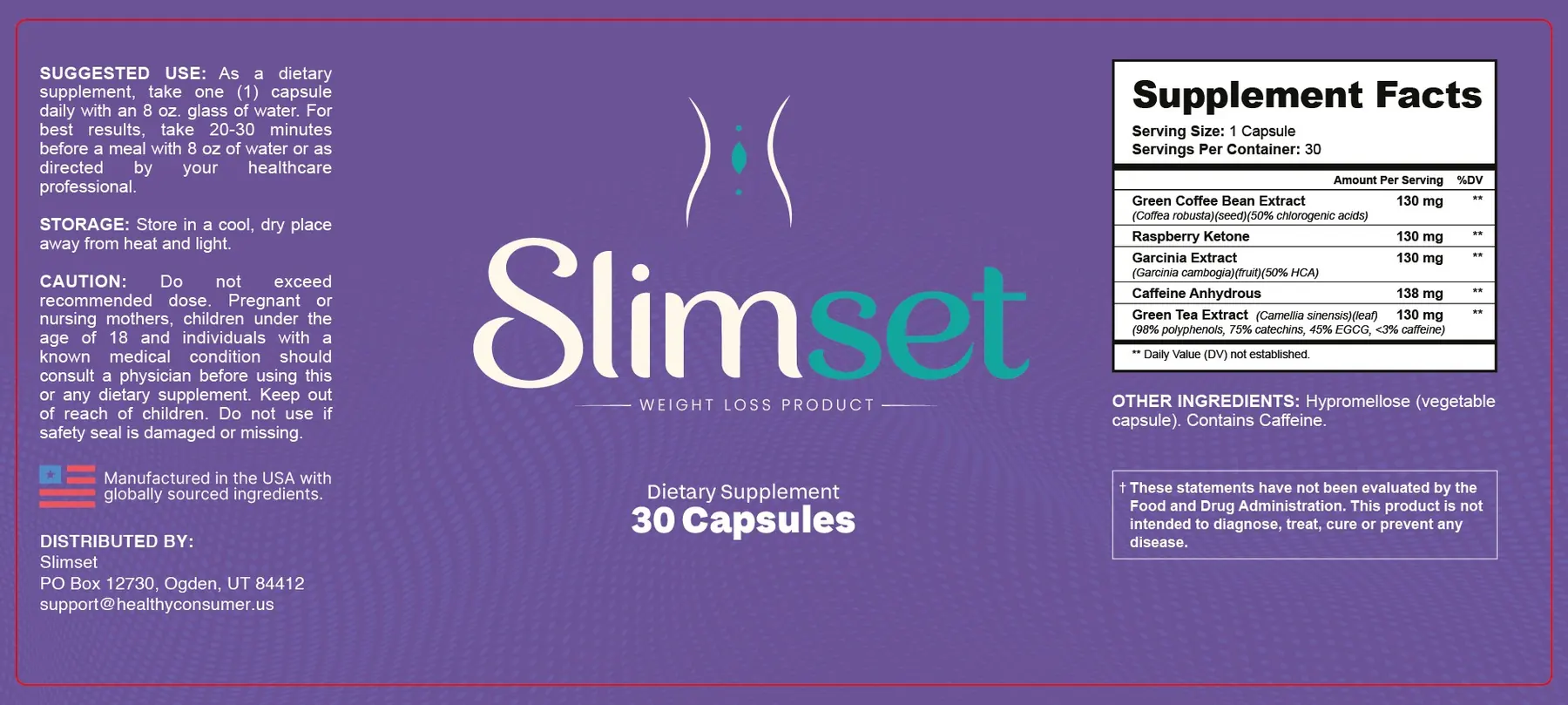
- No independent assay of SlimSet has been published. What the label offers is a printed caffeine figure that can be counted.
The question, and why it cannot be answered as asked
Type the question into a search box and you will get a chorus of yes and no from people with something to sell either way. The trouble is the noun. A weight-loss supplement can be a plain plant extract at a small dose, a stimulant blend, or in the worst cases a product with a drug in it that the label never mentions. Those three have almost nothing in common except the shelf they are sold from, and a single verdict on the shelf is a verdict on none of them.
So this article does not try to reach one. It does three smaller things. It reads the best-known national count of supplement-related emergency visits, and says what such a count can and cannot show. It reads two analyses that opened bottles instead of counting patients. And it goes through what applies to this particular label, which is unusually explicit about its contents and, by its own admission, untested by anyone outside the supply chain.
What the emergency-room data measured
The study most people mean is a 2015 paper in the New England Journal of Medicine by Geller and colleagues, drawn from a national surveillance system covering 63 emergency departments between 2004 and 2013. Their 3,667 cases were scaled up to national estimates: about 23,000 emergency visits a year attributed to adverse events related to dietary supplements, and about 2,150 hospitalisations.
Three findings in it matter here.
- Who turned up. Young adults aged 20 to 34 accounted for 28 per cent of visits, and unsupervised children for another 21 per cent. That second group is a storage problem rather than a formula problem, and it is worth remembering when the headline number sounds worse than it is.
- What kind of product. Once unsupervised child ingestions were set aside, about two-thirds of the visits for single-supplement events involved herbal or complementary nutritional products and about a third involved vitamins and minerals. Within that, the abstract names herbal or complementary products for weight loss (25.5 per cent) and for increased energy (10.0 per cent) as commonly implicated.
- What went wrong. Weight-loss or energy products caused 71.8 per cent of the supplement-related events that involved palpitations, chest pain or a fast heart rate, and 58 per cent of those involved people aged 20 to 34. Among adults over 65, by contrast, the leading problem was choking or difficulty swallowing pills, and it was mostly linked to micronutrients.
The paper’s own conclusion is that the visits commonly involve cardiovascular symptoms from weight-loss or energy products in younger adults. It is a fair reading, and it is the reason a caffeine capsule should be approached with some care rather than treated as a snack.
What a count of visits cannot tell you
Here is where a careful reader has to slow down, because a number like 71.8 per cent invites a wrong conclusion.
First, it is a share of events, not a risk per person. The study counted hospital visits. It did not count how many people were taking each kind of product. A product used by a great many people will supply more emergency visits than a rarely used one, even if the rarely used one is worse per capsule. Without the denominator of users, a percentage like this ranks categories by popularity as much as by harm.
Second, it does not name products or ingredients in the abstract. The heart symptoms are attributed to a class of product, and the class is defined by what the product was sold for, not by what was in it. A caffeine-heavy stimulant blend, a product with an undeclared drug and a mild plant extract taken by someone with an unrelated heart condition are all filed under the same heading.
Third, it cannot say anything about the individual product in your hand. A national estimate of this kind tells a clinician what to ask a young adult with palpitations. It does not tell you how a specific, fully declared, five-ingredient capsule at a stated dose compares with the shelf, and it would be dishonest to use it to condemn or to reassure.
What it does establish is a reasonable prior. If you are under 35, healthy and taking a stimulant for weight, you are exactly the group most represented among the cardiac-symptom visits, and that is a good reason to read the caffeine figure on the label before the first capsule and not after it.
What is actually in the bottle
The other half of the safety question is whether the label is telling the truth, and two analyses that opened products give a sobering answer for the category as a whole.
Crighton and colleagues screened regulated herbal medicines and supplements sold for diet, weight loss and cardiovascular health, using DNA sequencing together with mass spectrometry. Nearly half of the products tested had a contamination problem, in the DNA, in the chemistry or in both. Two were clear pharmaceutical adulterations. Others carried stimulants the label had not declared, such as caffeine, synephrine or ephedrine, and only 21 per cent of the products could have even one listed ingredient corroborated by DNA sequencing. The authors’ suggestion was stronger pre-market evaluation. The abstract does not claim to estimate how common the problem is across the whole market, and a reader should not treat it as if it did.
A more recent piece of work, by Longhi and colleagues, looked at exactly the ingredient that matters most on this panel. They developed a quantitative NMR method and used it on 11 real samples of caffeine-based thermogenic capsules. Six contained more than 115 per cent of the caffeine on the label. Three contained less than 85 per cent. One contained only 4.3 per cent of the stated amount. Eleven capsules is a small sample, and these were products sold as caffeine capsules rather than five-ingredient formulas. But it makes a point that is easy to miss: an amount printed on a label is a claim, and claims about caffeine have been found to miss in both directions.
Neither says that supplements in general are contaminated, and neither says anything about SlimSet. They say that the printed amount and the actual amount are two different things, and that only an assay can tell you how far apart they are.
The stimulant that is on the panel
Of the five rows on this panel, one is a stimulant at a meaningful dose: 138 mg of caffeine anhydrous, printed as its own row. The others are two botanicals with a small caffeine content, and two rows with no caffeine. So the safety conversation about the cardiac symptoms in the emergency-room data is, for this bottle, a conversation about one row.
That row has an unusually good reference point. A 2017 systematic review by Wikoff and colleagues screened more than 5,000 articles, took 381 studies through to assessment, and concluded that up to 400 mg of caffeine a day in healthy adults is not associated with overt adverse cardiovascular, behavioural, reproductive, developmental or acute effects, or effects on bone status. For healthy pregnant women the figure was 300 mg a day. The authors also said the field needed to focus on sensitive people and on people with existing conditions, which is where a population ceiling stops being reassuring.
| Reference point | Amount | One SlimSet capsule as a share |
|---|---|---|
| Healthy adults, daily total from all sources | 400 mg | 34.5% (138 mg) |
| Healthy pregnant women, daily total | 300 mg | 46.0% (138 mg) |
Percentages are 138 divided by the reference figure. They ignore the few milligrams the green tea row can add and any caffeine the green coffee row carries but the panel does not print. This website’s own line is that the capsule is for healthy adults of 18 and over and is not for anyone pregnant or nursing.
A third of the ceiling from one capsule is a comfortable place to start and an easy place to overshoot. The capsule is the smallest source of caffeine on many mornings, and the day it goes wrong is the one where it lands on top of a large coffee and a pre-workout drink. The caffeine article works through the dose-response evidence, and the sleep article covers when the capsule is best taken.
What applies to SlimSet, and what does not
Put the studies against the bottle and the picture is mixed, which is the honest shape for it to take.
What the label does well. It prints an amount against all five actives, so nothing is hidden in a proprietary blend. Caffeine is its own row, not buried inside a botanical, so it can be counted. Contains caffeine is stated in words. The only inactive ingredient is the hypromellose capsule shell. None of that guarantees safety, but it removes some of the failure modes the studies describe, particularly the undeclared-stimulant kind of surprise, at least as far as the printed claim goes.
What the label cannot do. A label is a claim. The batch verification page is unusually direct about it: the lot number and the certificate reference held against it are filing references rather than laboratory proof, no independent assay of SlimSet has been published, and this desk has not commissioned one. The testing and quality page audits the six marks on the pack and finds that none of the five compliance-style ones names a certifying body or a certificate number. Given what the Longhi analysis found about caffeine capsules generally, that is not a reason for alarm, but it is a reason to read the printed 138 mg as a stated amount and not a measured one.
What no study here covers. None of the four studies looked at this formula. The rows other than caffeine raise their own questions, and they are read elsewhere on this website: green tea extract and the liver, and raspberry ketone, which has no human trial at all. That is a different kind of gap from a contamination worry, and it points the same way: read before buying.
Before the first capsule
A short list of ordinary precautions follows from all of the above. None of it is dramatic.
- Count the day first. Total the caffeine you already have. The ledger on the how to use page takes about a minute, and the capsule’s 138 mg is the only figure in it that is printed rather than estimated.
- Check the bottle against the label. The six checks on the batch verification page need no equipment. If the safety seal is broken, the lot does not match or the other-ingredients line is longer than hypromellose, stop and call the desk.
- Think about who you are. Heart rhythm problems, high blood pressure, thyroid conditions, anxiety, pregnancy, breastfeeding, and regular medicines all change the arithmetic of a stimulant. A short conversation with the clinician who knows you costs less than the guess.
- Know what a red flag is. Chest pain, fainting, a racing or irregular heartbeat that does not settle, or trouble breathing after a capsule is a reason to stop taking it and get medical care promptly, not to see how the week goes.
- Use the window. The 60-day guarantee is a purchase policy, not a promise about the formula, but it does mean a first bottle is a low-cost way to find out how the caffeine suits you. One bottle is a month.
None of this needs a verdict on the whole category. It needs the ordinary care you would bring to anything that contains a stimulant, and a willingness to treat a printed number as a claim until somebody measures it.
A dietary supplement for healthy adults of 18 and over, not a medicine and not FDA-approved. Nothing here is medical advice. If you are unwell after taking any supplement, stop taking it and speak to a healthcare professional.
References
- Geller AI, Shehab N, Weidle NJ, Lovegrove MC, Wolpert BJ, Timbo BB, et al. Emergency Department Visits for Adverse Events Related to Dietary Supplements. N Engl J Med. 2015;373(16):1531-40. PMID 26465986. https://pubmed.ncbi.nlm.nih.gov/26465986/
- Crighton E, Coghlan ML, Farrington R, Hoban CL, Power MWP, Nash C, et al. Toxicological screening and DNA sequencing detects contamination and adulteration in regulated herbal medicines and supplements for diet, weight loss and cardiovascular health. J Pharm Biomed Anal. 2019;176:112834. PMID 31472365. https://pubmed.ncbi.nlm.nih.gov/31472365/
- Longhi GS, Crocoli LC, Armando YP, de Almeida RM, Schiavenin A, Moura S. Too much or too little caffeine? Determination of content in thermogenic capsules by quantitative 1H nuclear magnetic resonance (qNMR). J Pharm Biomed Anal. 2025;261:116832. PMID 40179616. https://pubmed.ncbi.nlm.nih.gov/40179616/
- Wikoff D, Welsh BT, Henderson R, Brorby GP, Britt J, Myers E, et al. Systematic review of the potential adverse effects of caffeine consumption in healthy adults, pregnant women, adolescents, and children. Food Chem Toxicol. 2017;109(Pt 1):585-648. PMID 28438661. https://pubmed.ncbi.nlm.nih.gov/28438661/
- SlimSet product label artwork, supplied in the vendor asset pack. Serving size one capsule, 30 per container; caffeine anhydrous 138 mg; other ingredients hypromellose (vegetable capsule); contains caffeine.